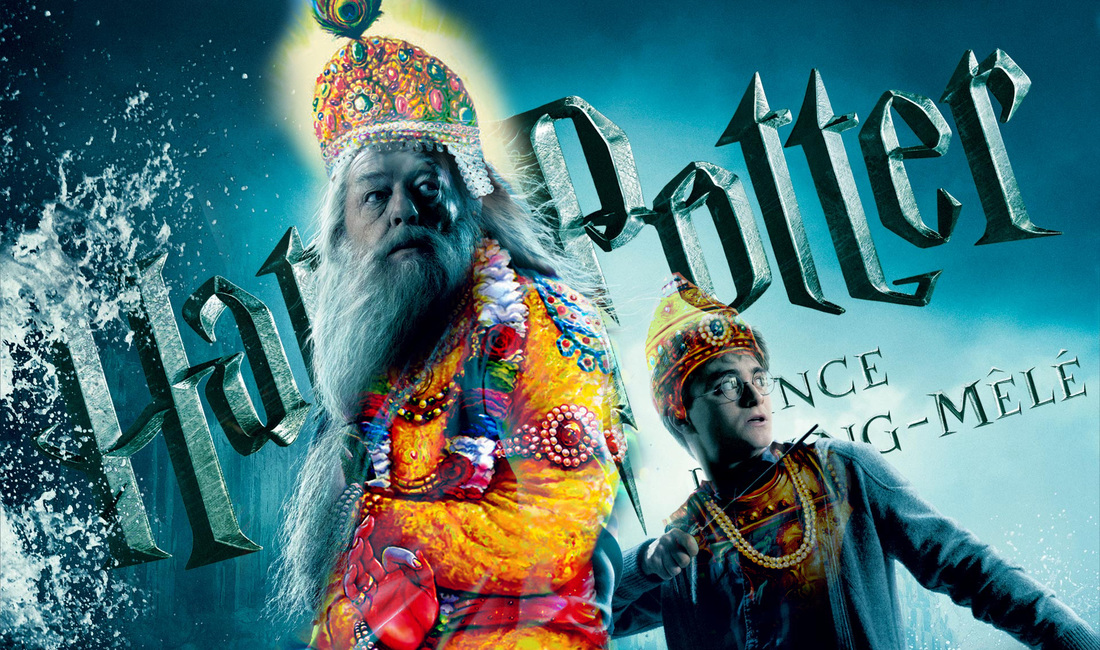
1. The Houses are totally paths of yoga. There are many paths to goodness–all are equal, all lead to the same place. Whichever one you take is your choice based on your constitution. The Gita describes four yogic paths to goodness. Rowling describes four Hogwarts Houses. Hmm…
Karma Yoga: the path of action, service to others, mindfulness, and remembering the levels of our being while fulfilling our actions or karma in the world. GRYFFINDOR!
Bhakti Yoga: Bhakti Yoga is the path of devotion, emotion, love, compassion, and service to God and/or others. All actions are done in the context of remembering purity and goodness. HUFFLEPUFF!
Jnana Yoga: Jnana Yoga is the path of knowledge, wisdom, introspection and contemplation. It involves deep exploration of the nature our being by systematically exploring and setting aside false identities. RAVENCLAW!
Raja Yoga: Raja Yoga is a comprehensive method that emphasizes meditation, while encompassing the whole of Yoga. It directly deals with the encountering and transcending thoughts of the mind. SLYTHERIN! (they can be good guys, too, ya know)
2. Harry is totally Arjuna and Dumbledore is totally Krishna. Harry is emotional and gets lost in debate within his own head a lot. Dumbledore always offers sagely words, especially at the end of each book. JK Rowling highlights Harry/Arjuna’s doubt a lot more than the Arjuna’s Gita–they are written in different times and therefore demand different twists in the story. In the end, we know that Harry knows his loyal, highest Self as his true self–not his emotional self.
“He accused me of being Dumbledore’s man through and through.”
“How very rude of him.”
“I told him I was.”
Dumbledore opened his mouth to speak and then closed it again. Fawkes the phoenix let out a low, soft, musical cry. To Harry’s intense embarrassment, he suddenly realized that Dumbledore’s bright blue eyes looked rather watery, and stared hastily at his own knee. When Dumbledore spoke, however, his voice was quite steady.
“I am very touched, Harry.”
3. The Battle of Hogwarts is totally The Battle of Kurukshetra. Obvious.
4. King’s Cross Station in Harry’s head is totally actual reality. Harry dies and then experiences a meeting with Dumbledore’s spirit in an empty, pure “imaginary” King’s Cross Station. The station represents a transitional, timeless space of spirit that confuses Harry as he is revealed truths beyond the illusionary world of physical sensation. What he finds is that the physical word is all an illusion, AND YET one must follow his/her path of goodness through the illusion. When Harry wakes up, he completes his duty to goodness by defeating Voldemort and freeing the world from evil.
“Of course it is happening inside your head, Harry, but why on earth should that mean that it is not real?”
5. The oldest magic of “love” is totally karma yoga. Choose your actions based on love without attachment to an personal/selfish outcome or consequence (balancing of Karma to end suffering). We talk about good karma and bad karma, and while good karma is indeed better, the Gita explains that any karma perpetuates a cycle of action, and therefore one can remain stuck in that cycle. Good karma is performing an action with attachment to something good–like I feed my owl because it makes me feel needed. Or I defeat Voldemort so I can look cool. (Bad karma is represented well by Draco and many of his friends.) Karma is neutralized through inaction, or action with attachment to a goal. Lily Potter does not care what she gets out of saving Harry–she dies as it is her duty to goodness and love. This magic trumps Voldemort’s shitty action, obviously. Harry then does the same, even though he is very afraid, by sacrificing himself in book 7 without wanting anything out of it for himself.
“Do not pity the dead, Harry. Pity the living, and, above all those who live without love.”
 janan comedian + yoga teacher site
Leave a comment